We also offer supply only shower screens - trade discounts apply!
We are looking for shower screen installers, apply here.
Are Shower Screens a Standard Size? Shower Screen Sizes Explained
Choosing a shower screen can feel straightforward until you start looking at widths, heights, doors, fixed panels and bath screens. One of the most common questions is whether shower screens come in a standard size that will simply fit the opening.
The short answer is that there are common shower screen sizes, but there is no single universal size for every bathroom. The right size depends on the finished opening, bathroom layout, door style, glass thickness, wall angles, shower position and how the screen will be fixed. That is why a custom-made shower screen is often a better fit than trying to make a fixed off-the-shelf size work.
Here is the Quick Answer
No, shower screens are not all a standard size. Some products are made around common dimensions and some framed or semi-frameless systems can allow a small amount of adjustment, but shower openings vary too much for one size to suit every bathroom.
As a practical guide:
Many shower screens are around 2,000 mm high, but the correct height depends on the design and fixing method.
Individual doors and fixed panels commonly fall within roughly 600 to 1,000 mm wide, depending on the screen type.
Common shower areas include layouts around 900 x 900 mm or 1,200 x 900 mm, but these are bathroom layout examples, not universal screen sizes.
Selected sliding screen systems may need an opening of around 1,100 mm or more.
Over-bath panels vary considerably. Ezy Glide has configurations with maximum panel widths ranging from about 700 mm to 1,050 mm, depending on the system.
The best approach is to measure the finished bathroom and size the glass, door and panels to suit the actual space rather than choosing a screen by a nominal size alone.
Quick shower screen size guide
| Layout or screen type | Typical example | Important note |
|---|---|---|
| Corner ensuite | Around 900 x 900 mm shower area | Overall bathroom layout example, not the glass panel size. |
| Main bathroom shower | Around 1,200 x 900 mm shower area | May suit hinged, sliding or multi-panel configurations. |
| Long walk-in layout | Around 1,400-1,600 x 900 mm shower area | The fixed glass panel is sized separately to control splash. |
| Selected sliding screens | Around 1,100 mm minimum opening | Applies to selected Ezy Glide semi-frameless and slimline configurations. |
| Selected over-bath panels | About 700-1,050 mm maximum panel width | Maximum depends on the specific framed, semi-frameless or frameless system. |
Here is the Detailed Answer
Are Shower Screens a Standard Size?
There are common sizes, but shower screens are not truly universal. Bathrooms that look similar on plan can end up with different finished dimensions once the tiles, bath, floor levels, wall angles and fittings are in place.
A standard-size screen can work where the opening is square, the dimensions suit the product and there is enough adjustment in the frame or channel. The difficulty comes when a bathroom is slightly out of square, the wall is not perfectly plumb, a vanity or toilet limits the door swing, or the shower head creates a splash zone that needs extra glass coverage.
Ezy Glide measures custom shower screens to suit the actual bathroom. If you are comparing custom and fixed-size products, see Custom Shower Screens vs Off-the-Shelf Shower Screens.
What Sizes Do Shower Screens Come In?
The answer depends on whether you mean the overall shower opening, the glass door, the fixed panel or the total enclosure. Those measurements are not the same thing.
The table below shows examples used in Ezy Glide’s existing product and sizing guides. They are useful for understanding the range, but they should not be treated as a standard-size chart for every installation.
| Screen type | Typical height | Typical door/panel width | Sizing notes |
|---|---|---|---|
| Frameless hinged | Up to about 2,000 mm in common examples | About 700-800 mm for a hinged door | 10 mm toughened glass is common. Wider or unsupported panels may need different hardware or bracing. |
| Frameless fixed panel | Up to about 2,000 mm in common examples | About 800-900 mm in common examples | Panel width and bracing depend on the layout and fixing points. |
| Frameless sliding | Up to about 2,000 mm in common examples | About 900-1,000 mm for a door panel in common examples | The overall opening may be much wider than a single door panel. |
| Semi-frameless | Up to about 2,000 mm in common examples | About 700-900 mm for a door or fixed panel | Channels and framing provide support and some systems allow limited adjustment. |
| Fully framed | Up to about 2,000 mm in common examples | About 600-900 mm for a door or fixed panel | The full frame supports the glass and can make sizing more forgiving. |
| Slimline sliding | Up to 2,000 mm for selected Ezy Glide systems | Selected configurations need about 1,100 mm minimum opening | Designed for bathrooms where a swinging door is impractical. |
| Over-bath screen | Varies by bath and system | About 700-1,050 mm maximum in selected Ezy Glide configurations | Bath shape, wall position, taps and access all affect the final panel size. |

How Wide Should a Shower Screen Be?
There is no one correct width. A shower screen needs enough glass to contain normal spray while still giving you comfortable access to the shower. The required width changes with the position of the shower head, the opening, the door style and whether there is a return panel.
When working out how wide a shower screen should be, consider:
The overall shower recess or walk-in area
Where the shower head points and where water is most likely to splash
The width needed for a comfortable entry
Whether the door swings into the bathroom or the shower
Nearby vanities, toilets, towel rails and doorways
Whether a return panel is needed to improve water containment
The glass thickness and hardware suitable for the panel size
For glass thickness guidance, see How Thick Should Shower Screen Glass Be?.
How High Should a Shower Screen Be?
Many modern shower screens are around 2,000 mm high, and Ezy Glide’s existing guides use examples up to this height across several screen types. That does not mean 2,000 mm is mandatory.
The best shower screen height depends on the ceiling height, shower head position, panel width, hardware, bathroom proportions and the level of splash control required. Extra-tall glass can also change the structural requirements, so height should be considered together with glass thickness and fixing method.
How Long Should a Walk-In Shower Screen Be?
A walk-in shower screen needs to be long enough to control splash without making the entry awkward. There is no fixed minimum length that suits every bathroom because water direction, shower head position, floor fall and the width of the walk-in area all matter.
Ezy Glide’s existing cost guide uses a long walk-in shower layout of roughly 1,400 to 1,600 mm by 900 mm as an example of the overall shower area. The glass panel itself is then sized separately to suit the opening and splash zone.
If space is tight, a slimline sliding shower screen can be worth comparing with a fixed walk-in panel because it avoids the need for a large door swing.
Are Shower Screens Universal?
No. Even when two shower screens have similar advertised dimensions, the glass, channels, hinges, rollers, wall profiles and clearances can be different. A screen designed for one system should not be assumed to fit another bathroom or another brand of hardware.
The finished opening is only one part of the decision. The installer also needs to consider wall condition, tile edges, floor levels, bath rims, fixing points and the way the door or panel operates.
Are Shower Screens Adjustable?
Some framed and semi-frameless shower screen systems have limited adjustment in their wall channels or profiles. This can help accommodate small variations in the opening. Frameless glass is much less forgiving because the glass is manufactured to the required shape and size, so accurate measuring is especially important.
Adjustment should not be used to compensate for a screen that is fundamentally the wrong size or layout. A custom measure allows the screen configuration to be selected around the bathroom rather than forcing the bathroom to suit the screen.
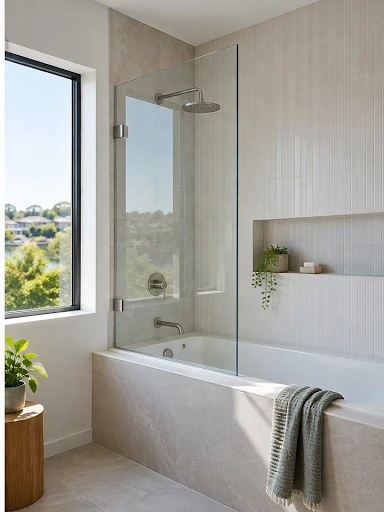
What Size Shower Screen Do You Need for a Bath?
Bath shower screens are a good example of why there is no universal size. The right panel depends on the bath edge, shower outlet, wall position, taps, access and how much of the splash zone needs to be covered.
Within Ezy Glide’s current over-bath range, selected configurations include:
A framed panel-only bath screen with a maximum width of about 1,050 mm
A semi-frameless panel-only option with a maximum width of about 700 mm
A semi-frameless glass panel on bath option with a maximum width of about 750 mm
Custom frameless bath panels and fixed/swing configurations sized to suit the bathroom
You can compare the available over-bath shower screen options, or read more about using a shower screen with a freestanding bath.
Why Accurate Measuring Matters
Shower glass is not something you want to force into an opening that is a few millimetres out. The finished bathroom can differ from the plans, and small variations become more noticeable with large sheets of glass.
A proper measure checks more than the width and height. It can identify:
Walls that are slightly out of plumb or out of square
Uneven tile lines or bath edges
Door swing conflicts with a vanity, toilet or bathroom door
Where the shower spray is likely to hit
Whether a fixed panel needs extra support
The best location for hinges, channels, brackets and seals
Whether the opening is better suited to a hinged, sliding, fixed, framed or frameless configuration
The goal is not simply to make the glass fit. The goal is to make the whole screen work properly in the room.
Standard Size vs Custom-Made Shower Screens
| Factor | Standard or adjustable screen | Custom-made screen |
|---|---|---|
| Sizing | Built around set dimensions with limited adjustment | Measured to the finished bathroom opening |
| Uneven walls | May need wider channels or larger gaps | Glass and configuration can be designed around the actual angles |
| Door and panel layout | Limited to the product configuration | Can be selected to suit access, splash and nearby fixtures |
| Finish | Can work well where the bathroom suits the product | Usually gives a cleaner fit in non-standard spaces |
| Best for | Straightforward openings that match the available system | Renovations, unusual layouts, premium finishes and bathrooms where fit matters |
Which Shower Screen Size Is Right for Your Bathroom?
Start with the bathroom layout rather than a nominal screen size. A small ensuite may be better suited to a sliding or carefully positioned fixed panel, while a larger bathroom may have room for a wide frameless hinged screen. Over-bath layouts need another approach again.
Ezy Glide offers frameless shower screens, semi-frameless shower screens, framed shower screens, slimline shower screens and over-bath options. Each has different practical sizing limits and hardware requirements.
If budget is part of the decision, see our guide to the average cost of a shower screen in Sydney.
Get the Right Shower Screen Size with a Free Measure and Quote
Ezy Glide custom-makes shower screens in Sydney and installs across Sydney and Wollongong. With more than 50 years in shower screens, our team can measure the finished space, recommend a suitable configuration and manufacture the screen to suit the bathroom.
Our shower screens are made in our Sydney factory, with professional installation and a 5-year warranty on workmanship and materials, excluding glass.
Planning a new shower screen? Contact Ezy Glide for a free measure and quote, or view our Sydney service areas.
FAQs
Are shower screens a standard size?
Not exactly. There are common dimensions, but the correct shower screen size depends on the finished opening, screen type, door style, glass thickness and bathroom layout. Custom screens are measured to suit the actual space.
Are shower screens universal?
No. Shower screens use different glass sizes, frames, channels, hinges and fixing systems. A screen with similar advertised dimensions is not automatically interchangeable with another system.
Are shower screens adjustable?
Some framed and semi-frameless systems allow limited adjustment in the wall channels. Frameless glass is generally made to measure, so accurate sizing is more important.
How tall is a shower screen?
Many modern shower screens are around 2,000 mm high, but there is no single required height. The final height depends on the screen design, bathroom proportions, glass size and hardware.
How wide should a shower screen be?
It should be wide enough to control normal shower spray while keeping the entry comfortable. The correct width depends on the shower head position, overall opening, door style and whether a return panel is needed.
How long should a shower screen be?
There is no universal length. For fixed and walk-in panels, the glass needs to extend far enough to manage splash without blocking access. The panel length should be chosen from the actual bathroom layout.
How long should a walk-in shower screen be?
Walk-in screens are sized around the shower area, spray direction and entry. Ezy Glide’s existing guide uses 1,400-1,600 x 900 mm as an example of a long walk-in shower area, but the glass panel itself is measured separately.
What size shower screen do I need for a bath?
It depends on the bath, wall position, shower outlet and access. Ezy Glide has over-bath systems with selected maximum panel widths from about 700 mm to 1,050 mm, plus custom frameless options.
Where should a shower screen sit on a bath?
The screen should be positioned where it can control the main splash zone without making bath access difficult. The bath rim, wall fixing, taps, shower outlet and waterproofed area all affect the best position.
How tight should a shower screen be?
A shower screen should not be forced tightly between walls or against other glass. The system needs the clearances specified for its hinges, channels, seals and movement. These are set during measuring and installation.